Klášter Sénanque je nejznámější cisterciácký klášter v Provence. Leží 3 km od středověké vesničky Gordes v departementu Vaucluse. Byl založen roku 1148. Za francouzské revoluce byl vyvlastněn a poté znovu založen. Název Sénanque vznikl pofrancouzštěním latinských slov „sine aque“, tedy „bez vody“.
Mniši se zabývají pěstováním levandule a proto při cestě z parkoviště vás uchvátí nádherný pohled na fialovo modrá levandulová pole, za nimiž stojí robustní a strohý klášter. Jeho provoz zajišťuje malý počet řeholníků. Klášter Sénanque je místo ticha a modliteb. Přístup k levandulovým polím není dovolen z důvodu jejich ochrany před poškozením. Je zde však malá levandulová zahrádka, kde se můžete vyfotografovat mezi kvetoucí levandulí.
Středověký klášter, postavený v 12. a 13. století zahrnuje staré koleje, klášterní kostel, klášter, místnost pro vytápění a kapitulu. Prohlídky bez průvodce jsou možné pouze v době od 9:45 do 11 hodin, kromě nedělí, Velkého pátku, Nanebevstoupení, Nanebevzetí Panny Marie a Svátku všech svatých. Prohlídka kláštera s průvodcem trvá hodinu a je ve francouzštině. Počet návštěvníků ve skupině je omezen na 50 osob, doporučuje se předem si prohlídku rezervovat. Během prohlídky je vyžadováno zachovávat ticho.
Lavender has been grown in Sénanque since the 1960s. It is a hybrid variety between the fine lavender and the spike lavender. It grows with cuttings. Kvete od konce května do června. Sklízí se koncem července a začátkem srpna. Po sklizni se z ní destiluje čistý přírodní olej.
Gordes je skalní vesnička ležící v pohoří Monts de Vaucluse, zvaném též velký a malý Luberon. Je oblíbená pro svůj neopakovatelný provensálský ráz. Zvláštní je její terasovité uspořádání. Nenechte si ujít návštěvu krásného románského kostela Sv. Firmina, přestavěného v 18.
Gordes mělo vždy velký strategický význam. Chránilo přístup k údolí Calavon. Bylo osídleno již v prehistorických dobách, kdy zde bylo oppidum. Osídlení zde bylo též v době římské. Během raného středověku v důsledku nejistoty spojené s mnoha invazemi se obyvatelé usadili kolem pevnosti. Stávající hrad pochází z desátého století a byl přestavěn v období renesance. Před válkou jej objevil kubistický malíř André Lhote. Postupem času sem přivedl další malíře, kteří zde čerpali inspiraci pro svá díla. Jeden z nich Victor Vasaley se výrazně zasadil o obnovu Gordes. Na své náklady zrekonstruoval zámek. Dnes je zámek sídlem Musée Pol Mara a sídlí zde také turistické informační centrum. Procházky půvabnými úzkými dlážděnými uličkami, které nabízejí posezení v příjemných kavárnách a restauracích, nikdy neunaví.
Další kapitoly regionu Luberon - If one region of Provence captures the country exactly as you imagine it - honey-coloured stone, lavender fields stretching to the horizon, villages perched on their hilltops, terraced vineyards - it is undoubtedly the Luberon. The Mas des Pampres is ideally located right at the edge of the Luberon, which means you can leave in the morning for Gordes or the Abbey of Sénanque, and return in the evening to watch the sunset from our terrace. The map above places the Luberon villages in relation to the Mas des Pampres. The Luberon is a limestone massif stretching for 60 kilometres between Cavaillon in the west and Manosque in the east, straddling the départements of Vaucluse and Alpes-de-Haute-Provence.
Tradition distinguishes Petit Luberon in the west (around Cavaillon, Ménerbes, Lacoste, Bonnieux) from Grand Luberon in the east (around Apt, Saignon, Cucuron). For our English-speaking guests, the Luberon may already feel familiar even before you arrive. It is the Provence that Peter Mayle made famous to the anglophone world in A Year in Provence (1989), written from his home in Ménerbes; the landscape of Ridley Scott’s A Good Year (2006), filmed largely at Bonnieux and Château La Canorgue; and the setting of countless documentaries, travel magazines and lifestyle books over four decades. From Cabannes, you reach the heart of the Luberon by taking the D2 then the D900 - a peaceful road that follows the Durance, crosses Cavaillon, and disappears into the vines towards the hills. Allow about 35 minutes for Gordes, 40 minutes for the Abbey of Sénanque, and 35 minutes for Roussillon.
Pokud byste měli navštívit jen jedno místo v Luberonu, byl by to Gordes. Listed among the Plus Beaux Villages de France, it was even voted the most beautiful village in the world by the American magazine Travel + Leisure in 2023, ahead of Shirakawa-go in Japan and Giethoorn in the Netherlands. The village is discovered on foot, by wandering through its cobbled lanes, known here as calades. The Renaissance Château dominates the main square. The vaulted cellars beneath the tourist office: six underground rooms from the 12th century, once used for olive-oil pressing and wine storage. The Pol Mara Museum, dedicated to the Flemish painter who lived in Gordes for thirty years. The Tuesday morning Provençal market, one of the most iconic in the region. The Bories Village, two kilometres outside Gordes: a hamlet of restored dry-stone huts, a striking witness to the pastoral architecture of the 17th-18th centuries. Parking: the centre of the village is pedestrianised. Three free car parks at the foot of the village - allow 10 minutes’ walk up to the château square. A small belvedere on the right offers the postcard panorama - the cascading houses, the château, the church.
Abbey Sénanque is considered one of the finest examples of primitive Cistercian architecture alongside Silvacane and Le Thoronet: bare stone, pure lines, an absence of ornamentation. The lavender bloom at Sénanque happens each year from mid-June to mid-July, peaking generally around 5-15 July. This is undoubtedly the most magical moment to discover the abbey, but also the busiest. The abbey can be visited only on guided tours, in French, by reservation, outside the religious offices. The tour lasts about an hour and includes the abbey church, the cloister, the chapter house, the dormitory and the refectory. The monastic shop sells the community’s products: essential oil of lavender, honey, liqueurs, books.
On the edge of the Luberon, about twenty minutes from Sénanque, the village of Fontaine-de-Vaucluse is home to one of the most spectacular natural phenomena in Provence: the source of the Sorgue, which surges up at the foot of a high cliff in a rocky amphitheatre. In 2024, the site joined the prestigious list of the 200 IUGS Geological Heritage Sites (International Union of Geological Sciences). The spectacle varies with the seasons: dramatic and surging during snowmelt and after rain (the flow can then exceed 80 m³/s), calmer in summer when the level drops. The village itself rewards a stroll - the Vallis Clausa paper mill, the Petrarch museum, and the terraces set along a Sorgue of translucent green.
East of Gordes, Roussillon is unique in its kind: the only village in the Vaucluse built entirely from red ochre. A short walk from the village, the Ochre Trail takes you into a former open-pit quarry, in a landscape of fairy chimneys, red cliffs, orange sands and green pine groves. Two loops to choose from: short circuit (30 minutes, 700 metres) or long circuit (50 minutes, 1.5 kilometres). The trail is open all year round. Moderate fee (around €4 per adult, free for children). Two kilometres from Roussillon, the Okhra - Conservatory of Ochres and Colour tells the story of ochre extraction in the Vaucluse. Free visit of the industrial site, painting workshops for adults and children, shop of pigments and brushes. The village itself deserves an hour’s stroll.
About ten kilometres south of Gordes, three villages rise along the slopes of the Petit Luberon: Bonnieux, Ménerbes and Lacoste. Bonnieux is one of the largest villages in the Luberon, tiered along the northern flank of the mountain. Ménerbes is perhaps the most discreet of the three villages, but also one of the most moving. Lacoste, more modest in size, owes its fame to its ruined château - that of the Marquis de Sade. If you are staying for a week at the Mas des Pampres and want to devote most of your time to discovering the Luberon, here is how we suggest you organise your days. Morning in Gordes, lunch on a village terrace, afternoon at the Bories Village. Quiet morning at the Mas. Leave around 11am for Roussillon, lunch in the village, afternoon on the Ochre Trail + Conservatory Okhra. A full day exploring the three villages at a leisurely pace. Lunch stop in Bonnieux or Ménerbes.
La Luberon is a major destination for Provençal gastronomy. La Bastide de Gordes in Gordes, Capelongue in Bonnieux, La Coquillade Provence in Gargas, Auberge La Fenière in Cadenet, Domaine de la Citadelle in Ménerbes; a number of high-end restaurants and wine estates offer remarkable experiences. Mas des Pampres is ideally located for exploring the Luberon at your own pace. → April-May: spring, wild flowers, awakening gardens, mild temperatures, fresh light. → Mid-June to mid-July: the lavender season at Sénanque.
Jeden z mnoha cisterciáckých klášterů ve Francii vznikl na území pánů z Gordes v údolí Senancole. Jeho název už měl stavebníky varovat, neboť vznikl pofrancouzštěním latinských slov sine aqua, tedy bez vody. Založili jej biskup z Cavaillonu a provensálský a barcelonský hrabě Ramon Berenguer II. Klášter byl záměrně umístěn v nehostinných podmínkách daleko od civilizace, aby řeholníky nic neodvádělo od jejich poslání a mohli dle požadavků svatého Benedikta žít život v prostotě, naplněný prací a odříkáním. Stavba kláštera trvala přes 100 let a brzy se stal natolik populárním, že ho bohatí lidé i panovníci zahrnovali nejen štědrými dary, ale i pozemky. Kromě vnitřních problémů jsou však dějiny kláštera plné i ničení a válek. Roku 1544 byl zničen heretickým hnutím valdenských, kteří neváhali pověsit všechny místní obyvatele, a během Velké francouzské revoluce bylo roku 1791 opatství prodáno státu. Znovu ožilo v polovině 19. století, kdy sem přišlo 72 mnichů z opatství Lerins, kteří však museli odejít v roce 1903 v důsledku nového francouzského zákona o náboženských kongregacích. Financování chodu kláštera zajišťují jeho obyvatelé pěstováním levandule, prodejem levandulových produktů a oblíbeného medu. Částečně do pokladny přispívá i vstupné, neboť tu probíhají prohlídky s průvodcem. Rada: Přestože to tak v létě při nájezdu turistů nevypadá, nejedná se o turistickou atrakci, ale o funkční klášter. Klášter není turistickou atrakcí, ale živoucím řádovým sídlem? Proto je tu nutné zachovat klid a zvolit vhodné oblečení - ženy i muži by měli mít zahalená ramena i kolena.
V tichu a klidu ztraceného údolí Sénanque založil řád cisterciáků jednu ze tří „cisterciáckých sester“ v Provence. Stejně jako v kláštech Silvacene a Le Thoronet se i tady chtěli mniši vrátit, odloučeni od shonu ve světě, k původnímu učení sv. Benedicta. Roku 1098 byl však opat benediktinského kláštera v Molesme nespokojen s tamními pořádky a chtěl se distancovat od místního luxusu a vrátit se k čistým regulím sv. Benedikta, k jeho heslu Ora et labora (modli se a pracuj) a soustředit se na prostý život a odříkání. Po něm následující opat Alberich klášter se svolením papeže osamostatnil od benediktinského řádu a založil řád nový, podřízený přímo svatému otci. Jeho název odvodili z latinského názvu místa, kde byl klášter založen: Cistercium, tedy cisterciáci. Členové řádu se vrátili k myšlenkám sv. Benedikta ze 6. století.
Již pět let po založení vstoupil do kláštera v Cîteaux novic Bernard. Tento charismatický mladý muž už od roku 1125 zastával funkci opata a stal se vůdčí osobností celého řádu. Jeden z nich, klášter Sénanque, vznikl na území pánů v Gordes v provensálském údolí Senancole pod patronací biskupa z Cavaillonu a Ramona Berenguera II., hraběte provensálského a barcelonského. Stejně jako ostatní cisterciácké kláštery byl postaven v odlehlých nehostinných končinách, aby řeholníky nic neodvádělo od jejich poslání. Základní požadavky sv. Benedikta zahrnovaly jednoduchost a bez ozdob, aby nic neodvádělo k modlitbě.
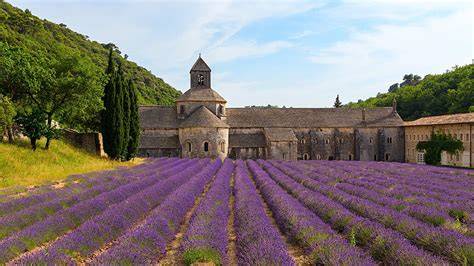
Nové kláštery byly zakládány uprostřed neobdělávané půdy, aby ji mniši mohli kultivovat, a u vodního toku, který by jim zajistil přísun pitné vody. Stavba celého kláštera trvala přes sto let, ale už ve 13. a 14. století se řád stal tak populárním mezi panovníky, že ho zahrnovaly pozemky a bohatými dary. Klášter v Sénarque v té době vlastnil rozsáhlé pozemky s vesnicemi i sedm farem a několik mlýnů. Od 16. století čelil dalším výzvám, až byl roku 1791 prodán státu během revoluce. Život se sem vrátil roku 1857, kdy sem přišlo 72 mnichů z opatství Lerins, kteří k původnímu klášteru připojili nové křídlo, v němž bydleli. K snad definitivní změně došlo o třicet let později. Roku 1988 sem na základě smlouvy s opatstvím Lerins přišlo deset členů řádu a zhruba stejný počet řeholníků zajišťuje chod kláštera dodnes.
Klášter je totiž možné navštívit s průvodcem. Ten sice mluví jen francouzsky, ale k dispozici tu máte i tištěný text v angličtině. I když se na prohlídku nedostanete, zamilujete si pohled na strohou robustní stavbu působící svým jednoduchým půvabem.