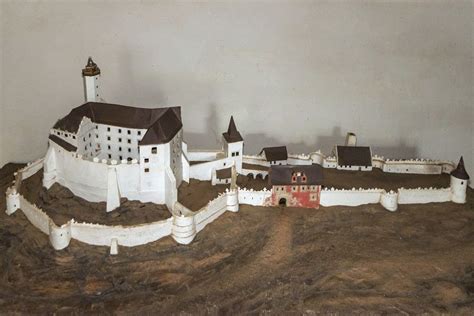
Dubbed as the architectural gems of Grodno, one of the most beautiful cities in Europe, the Old Castle and the New Castle rise high on the right bank of the Neman River. They witnessed landmark meetings, high-profile political events and luxurious balls, and hosted outstanding figures of various times. The Old Castle and the New Castle of Grodno are the only royal residences that survived on the territory of Belarus.
Grodno is often called the "royal city", but, undoubtedly, more accurately it is "a grand-ducal-royal city".
Základy a počátky Grodna
The history of the castle in Grodno began many centuries ago. In the 12th century, Grodno was the center of a principality with a defensive fortress surrounded by a moat and a ravine. In the 14th century, Grand Duke of Lithuania Vitaut had his residence built on the ancient Zamkovaya Gora (Castle Hill) and its story is inextricably linked with the life of the legendary ruler. According to a legend, the 1398 fire almost destroyed the castle and nearly killed its owners. It was a monkey who woke up the guard and saved Vitaut and his wife from imminent death. To make sure a fire did not happen again, Vitaut ordered to build a Gothic stone castle on the site of the former wooden buildings. The castle was rebuilt in 1400. Back then, it was a formidable fortification with five towers and massive walls up to three meters thick.
Starý hrad a jeho proměna
Construction of a residence for King of Poland and Grand Duke of Lithuania Stephen Báthory began in Grodno in 1579. Most likely, a group of architects involved famous Florentine Santi Gucci but no accurate information on this has survived. On the site of the Gothic Upper Castle of Vitaut, a new citadel was erected that later received the name of the Old Castle. The dominating part of Stephen Báthory’s residence was a Renaissance palace which had two floors with separate entrances. The first housed an arsenal, a chancellery, a treasury and other palace services. The second floor held the royal chambers - residential and ceremonial ones. The Grodno residence embraced the royal luxury of a palace and the defensive functions of a castle-outpost. The castle was seriously damaged during the Russo-Polish War of 1654-1657. Its restoration was supervised by Chief of the Grodno municipal administration and Lithuanian chancellor Krzysztof Zygmunt Pac. In 1673 a decision was taken to hold every third Sejm of the Polish-Lithuanian Commonwealth in Grodno (along with Warsaw). The first Sejm took place there in 1678-1679. A special building was erected on the grounds of the Old Castle for this purpose. The fire of 1735 also caused great damage, after which large-scale reconstruction began. Saxon architect Carl Friedrich Pöppelmann proposed fundamental changes. Palace windows were reduced, a third floor was erected above the central part under a four-pitched roof, the external staircase became internal.
For 120 years, the castle was under the jurisdiction of the military administration of the Russian Empire, and in 1924 it was rededicated as a museum. In 2017 a large-scale effort was mounted to restore the Old Castle, to preserve this unique historical monument and architectural specimen, to make it the city’s tourist gem. The first stage was completed in November 2021. The third stage provides for the restoration of the corner tower, outbuildings and the Lower Church of the 12th century. In November 2021, after a three-year break, the Old Castle Museum re-opened for visitors. It would not be an overstatement to say that the renewed exposition is unique. Most of the valuables were put on display in 2021, including artifacts found during the digs on Castle Hill. A separate room is dedicated to King Stephen Báthory. One of the halls has a copy of a medieval printing press. Exhibition halls of the Old Castle (there are eight of them in total) use both traditional and novel formats of presentation. The latter includes videos created using 3D mapping, interactive showcases and multimedia kiosks, touch screens with information about the exhibits. An observation platform was installed at the Old Castle. Visitors can enjoy beautiful views of the Neman River, the ancient Kolozha Church and, of course, the New Castle standing nearby.
Nový hrad: rococo a politické centrum
The New Castle is another royal residence located in Grodno. Built in the 18th century, this palace played a remarkable role in the history of Europe. However, the area itself was inhabited since ancient times. Over the centuries, there were various buildings there - a residential settlement with a stone church, the Lower Castle with the Royal House (Domus Regia), administrative buildings where local sejms and court sessions were held, the house of the security chief, a kitchen and a bakery, premises for guards and royal servants. A decision to build a new palace here was taken at a meeting of the Great Sejm of the Polish-Lithuanian Commonwealth in 1726, during the reign of Augustus II the Strong. The new palace was supposed to be used as a summer residence of the monarch and as a meeting place for the Sejm. Most researchers believe that the project designer was the famous Saxon architect Carl Friedrich Pöppelmann, who served at the court. The late Baroque (Rococo) palace was finished in 1742, and formed a single complex together with the Old Castle. According to the architects' plans, the U-shaped building (the main building with side wings) was functionally divided into two parts: one contained living quarters and halls for VIPs, the second was intended for meetings of the Sejm. In the late 18th century a magnificent royal chapel with a dome was built in the residence, and another building was erected for the needs of the estate-representative body. The outside of the New Castle looked much more simple than its interior. Striking Rococo decor suited the taste of the last king of the Polish-Lithuanian Commonwealth, Stanislaw II August Poniatowski, who loved luxury and spectacular receptions. The largest hall of the castle - the Senator's Hall - occupied two floors, and there was a special gallery for the queen and foreign ambassadors in its upper part. The Oval Hall, connected to the chapel by a passage, served as a royal reception room. The chambers of the palace were decorated with gilded panels, fine stucco work, splendid paintings and sculptures. Magnificent interior frescos were added during the reconstruction under the supervision of the architect Giuseppe de Sacco in the 1880s. They were made according to the designs of the chief royal painter Marcello Bacciarelli.
Significant political events took place in the New Castle in Grodno. Finally, it was the New Castle of Grodno that witnessed the dramatic and fateful Sejm of 1793. It culminated with the historical ‘silent meeting’ on the night between 23 and 24 September. During the 1794 uprising led by Tadeusz Kosciuszko, the resistance leader himself came to Grodno and participated in a meeting of the leaders of the insurgent units of the Grand Duchy of Litva (Lithuania) in the New Castle. The partitions of the Polish-Lithuanian Commonwealth determined the fate of Grodno and its royal residences, which became part of the Russian Empire. After the suppression of the Kosciuszko rebellion in 1795 the last Polish king and Grand Duke of Lithuania Stanislaw August Poniatowski returned to the New Castle. He abdicated on 25 November 1795 and lived there under the house arrest together with his family till 1797. By the decision of Catherine II he was allowed to receive guests and to travel around the region under the supervision of the Russian escort. In February 1797 Stanislaw August Poniatowski left the New Castle of Grodno for St. Petersburg at the command of Emperor Paul.
Současný stav a muzeální dědictví
The Great Patriotic War brought great destruction to the border city of Grodno. In 1952 the decision was made to reconstruct the New Castle and use it as an administrative building. The architect Vladimir Varaksin worked on the project and reconstructed the castle in the Neoclassicism style of the Soviet era, or Stalin's Empire style. The Communist Party of Belarus stationed its regional committee in the New Castle for a long time. In 1991 the castle housed a scientific library named after Yefim Karsky and the Grodno State Museum of History and Archeology. The premises of the New Castle have been converted into exhibition halls and storerooms. The historical layout, even after a rather liberal reconstruction in the 1950s, has partially remained unchanged.
Starý hrad a Nový hrad jsou součástí muzejního komplexu Grodno State Museum of History and Archaeology. Prohlídky s průvodcem jsou k dispozici v běloruštině, ruštině a angličtině. Vstupenky lze zakoupit na místě nebo online. Starý hrad patří k nejlépe dochovaným renesančním pevnostem ve východní Evropě. V průběhu staletí se u Grodna odehrály i menší střety během povstání v 19. století a dále.
Historické památky a další architektura v Grodně
Kaložský (Borisoglebský) kostel pochází ze 12. století. První písemná zmínka o Grodně a stavba Kaložského kostela spadají do 12. století. Kostel sv. Stanislava, chrám Pokrovskij, Kołodziejsky dům a další historické objekty doplňují muzeální komplex a tvoří atmosféru města. Nejstarší dochovaná stavba v Grodně, datovaná do 12. století, je Kaložský kostel. Starý hrad a nový hrad jsou také spojeny s bohatou historií regionu a evropským dědictvím.
Pro české návštěvníky je Grodno atraktivní destinací pro jednodenní i vícedenní pobyty s možností organizovaných i samostatných výletů. V centru města najdete hotely, jako Hotel Belarus či Hotel Grodno, a nabídka ubytování je různorodá. Oficiální měnou je běloruský rubl (BYN). Větší hotely a obchody přijímají karty, menší podniky preferují hotovost. Ano, město má síť autobusů a trolejbusů. Jízdenky se kupují u řidiče nebo v automatech.
| Památky | Rysy | Hlavní architekt |
|---|---|---|
| Starý hrad | Renesanční palác, armory, salón výrnků | Stephen Báthory; později Pöppelmann |
| Nový hrad | Rococo interiéry, Senator’s Hall, Oval Hall | Carl Friedrich Pöppelmann |
| Kaložský kostel | 12. století, dřevěná a kamenná stavba | - |
Pokud máte jen jeden den, začněte u Kaložského kostela, pokračujte na Starý hrad a zakončete procházkou po Sovětské ulici. Vízová povinnost platí pro všechny cesty do Běloruska. Bez víza se do země nedostanete ani na jeden den.