Necelých 20 km jihozápadně od Prahy se nachází místo, kde se podle legendy v 2. polovině 9. století usadil první poustevník v Čechách. Byl jím svatý Ivan, jehož postříbřená a pozlacená schránka s ostatky je umístěna uprostřed kostela Narození sv. Jana Křtitele ve Svatém Janu pod Skalou.
Raně barokní stavba mohutných rozměrů s bohatou vnitřní výzdobou byla postavena slavným architektem Carlem Luragem v roce 1661, v roce 1711 pak byl kostel staticky zajištěn K. I. Dientzenfoferem. Z kostela vede vchod do jeskyně sv. Ivana, jeskyni vévodí portál starého renesančního kostelíka Panny Marie, vytesaného ve skále původní travertinové jeskyně. Z jejího podloží vyvěrá mocný krasový léčivý pramen.
Celá obec, jíž dominuje areál bývalého benediktínského kláštera, je situována v srdci národní přírodní rezervace Karlštejn. In this week's Spotlight, we visit the picturesque little village Svaty Jan pod Skalou, some thirty km southwest of Prague and only nine kilometres away from the popular gothic Karlstejn Castle. Despite a population of only 120, Svaty Jan pod Skalou, translated into Saint John under the Cliff, boasts a large number of beautifully preserved historical monuments. This, thanks to the efforts of the St. John Society, which was established by local inhabitants after the fall of Communism to restore and bring back to life the treasures, left unattended and damaged by the Communist government.
Such as the St. John Benedictine Monastery that served as a labour camp, a prison, and a school for the secret police during the Communist regime. For that very reason, Svaty Jan pod Skalou was not found on a map and hence saw its historical monuments left in a dilapidated state. The stately building of the former monastery now dominates the village, with the church spire the oldest preserved part of the complex. But it was actually erected at a site some thirty kilometres away in the year 999.
After the building came under attack during the Hussite Wars in the fifteenth century, its monks came to Svaty Jan to build this new monastery. But as Mr Bohumil Sevcik from the St. John Society explains, it was not to serve its original purpose for long: "Our monastery grew after the Hussite Wars but in 1785, it was closed down by Emperor Joseph II. After this date, the building of the monastery was sold to some people who used it as a castle until the end of the nineteenth century."
From the start of the twentieth century, it was used as a spa for the recreation of people but in 1915, a school for the education of new teachers was founded here and it was here up to WWII. During the Second World War, it was closed by the German government. After the war, in the communist times, it was rebuilt as a labour camp and was a prison later up to 1955. After this period, it was rebuilt again as a school for police men and now after the revolution, it is used as a school for young girls and boys and they study here for three years to become teachers.
Although tucked away among the breathtaking green countryside of forests and creeks, and hidden under numerous cliffs and rocks, Svaty Jan pod Skalou has not gone unnoticed. In his book "Prague: Between History and Dreams", writer, geologist, and philosopher Vaclav Cilek describes the beauties of St. John under the Cliff: "Few places outside Prague have so captured the imagination of Bohemia's poets and writers during the past four hundred years. Here, kings and emperors dwelt, early Renaissance scientists observed the formation of stalagmites and stalactites in a nearby cave, writers of Baroque legends composed their verses about wise and bearded hermits, 19th century writers tried to revive past glory."
Saint Ivan, photo: www.svatyjan.cz Just by the monastery, we find the baroque Church of St. John the Baptist. Built in 1661 on the site of an older church, of which only the tower has been preserved, it has undergone several alterations but retained its original Baroque interior. A massive cross that used to stand on Prague's Charles Bridge and a seventeenth century painting depicting the revelation of St. John the Baptist to the Hermit Ivan rise over the altar. In the centre of the church stands the artfully crafted tomb of Saint Ivan.
So who was Saint Ivan and why is the church named after St. John the Baptist? "The name has its root in the Middle Ages, at the end of the ninth century. At that time, the first Christian Monk Ivan came here and lived in the cave (we will go to the cave later) and he lived here for forty-two years. Legend says that Ivan had to first fight the devil, so he wanted to go away. In his sleep appeared St. John the Baptist, who gave him the Saint [Holy] Cross and told him to return back to the cave and defeat the devil with the cross. So, Ivan returned to the cave and won against the devil and later he met with the Czech Duke Borivoj who promised to build a Chapel in the name of St. John the Baptist."
Excerpt from Vaclav Cilek's book: "From the Church of St. John, you enter the second, underground chapel in a former cave that was enlarged by the monks. You kneel at the stone where, according to a legend, the hermit Ivan prayed, placing your forehead on the small depression in the stone to become unified with the touch of St. Ivan and so many pious pilgrims. And then, in the cave, you sense the underground spring beneath your feet..."
Bohumil Sevcik: "This cave is only one of three hundred caves in our protected area and in this cave only lived monk Ivan for probably forty-two years." So, we're inside the cave now. Can you tell us what the little opening on the ceiling represents? There is a legend that is connected to this opening, isn't there?"
Yes, legend says that Ivan had to fight against the devils and that the devils disappeared through this hole in the ceiling. So since that time it is called the Devils' Hole. Ivan lived only in this part of the cave that is around this hole." Right next to the church, under the window of Ivan's cave, is St. Ivan's Spring, a strong hot well that legend says locals used to cure disease. Water from local springs also used to be bottled up and sold as the mineral water 'Ivanka'.
Since its foundation, the St. John Society has managed to raise over five million Czech crowns. In 1999, its efforts were paid off when Svaty Jan pod Skalou was rated as the third most beautiful village in the country. But that does not mean that there is no more work to be done. The St. John Society's next project is the restoration of a baroque Marian sculptural group and the ceiling and old pipe organ of the Church of St. CHYBA 429 - PŘÍLIŠ MNOHO POŽADAVKŮ...
1100. výročí smrti sv. Ludmily realizoval spolek Svatá Ludmila 1100 let, který zaštiťoval oslavy a všechny akce zaměřené na připomínku odkazu sv. Ludmily. Obec se stala svatoludmilským místem díky legendě, která vypráví o poustevníkovi Ivanovi, jehož laň postřelil na lovu kníže Bořivoj. Tato příhoda vedla k objevení Ivanovy poustevny a později také k setkání Ludmily s Ivanem na již zmiňovaném Tetíně.
Naučné stezky a turistické trasy
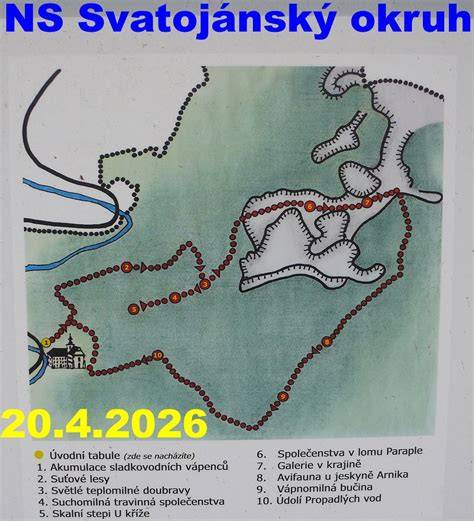
Hezká procházka se nabízí po Naučné stezce "Svatojánský okruh" v délce 4,5 km. Okruh začíná na Svatojánské návsi. Vede k vrcholu na skále s křížem. Dále stezka pokračuje přes starý lom Paraple, kde je možné navštívit skanzen těžby vápence. Pokračuje okruhem přes tzv. Stydlé vody a po necelé hodince cesty se vrací zpět do Sv. Jana. Naučná stezka byla vybudována správou CHKO Český kras v roce 1984.
Od kláštera se k vyhlídce dostanete po červené turistické trase. Cestou na vyhlídku narazíte na kapli Povýšení sv. Kříže. Podle pověsti stojí na místě, kde se poustevníku Ivanovi zjevil sv. Samotná kaple vznikla v roce 1714 z iniciativy opata Koterovského, autorem návrhu byl patrně Kryštof Dienzenhofer.
- Historické památky s bohatou výzdobou
- Kostel Narození sv. Jana Křtitele
- Jeskyně sv. Ivana a St. Ivan's Spring
- Naučná stezka a vyhlídky nad skalami
V roce 1999 byla obec oceněna jako třetí nejkrásnější vesnice v Česku díky práci a podpoře Spolku Svatá Ludmila, který usiluje o zachování a obnovu bohatého dědictví místa. Díky tomu dnes návštěvníci mohou obdivovat původní goticko-barokní prvky a důležité historické vztahy mezi mnichy, kněžím a místní komunitou.